
Arrest Warrants in DeKalb County
DeKalb County arrest warrants start with a complaint, not an arrest. A judge or magistrate reviews the facts for probable cause, and only then signs paper that lets officers take the named person into custody. Alabama Rules of Criminal Procedure 3.1 through 3.3 govern how a warrant is issued, what it must contain, how it is executed, and how it comes back to the court. Ala. Code §12-17-251 gives magistrates the arrest-warrant authority to do it. DeKalb County's courts split the work. Circuit Court tries felonies as the general-jurisdiction court, while District Court handles felony preliminary hearings and misdemeanors outside city prosecution. Municipal Courts take city matters within their limits. Whatever the level, the issuing clerk is the office that confirms what a warrant actually says.
DeKalb County Arrest Warrant Path
The path runs through a few set steps. A complaint gets filed first. A judge or magistrate then weighs whether the legal threshold is met, and that neutral review is what turns an allegation into authority to arrest. The signed warrant may list the issuing county, the court, a complaint reference, the agency, and the issue date. Keep it distinct from a search warrant. That second document lets officers look for evidence under Rules 3.6 through 3.14 and is not something you can look up on your own. For files, DeKalb County Circuit Clerk Todd Greeson holds the Circuit and District records, and each city clerk keeps the municipal ones.
What a DeKalb County Arrest Warrant Contains
The official AOC manual lays out the fields a warrant carries, but the warrant portal itself stays restricted to law enforcement. Private identifiers that exist inside those systems do not become public just because they are stored. When you ask about a DeKalb County warrant, request only the fields you need to confirm your own record and route the case.
| Warrant number | Links the process to the issuing system and file. |
|---|---|
| Name and DOB | Distinguish similar names; DOB may be restricted. |
| Charge | Names an alleged offense, not a conviction. |
| Issuing court | Identifies the clerk who can confirm the file. |
| Bond | May show a type or amount if releasable. |
| Status and date | May show requested, issued, executed, recalled, or denied. |
Call About a DeKalb County Arrest Warrant
The Sheriff FAQ sends outstanding-warrant calls to (256) 845-8560. Have the legal name, date of birth, any former name or alias, and the case number ready. Ask which court and agency own the DeKalb County warrant, whether it is issued or already served, and what bond type staff can state.
- Confirm the exact identity match.
- Record the court, agency, number, date, and status.
- Call the jail at (256) 845-8565 about custody and bond routing.
- Ask counsel and the issuing office how surrender should occur.
DeKalb County publishes no walk-in surrender handout and promises no arrest-free treatment. Call ahead before you travel.
How DeKalb County Arrest Warrants Are Served
Service runs through the sheriff's office. Its administration page lists an NCIC Clerk and a Warrant Clerk who enter warrants, route process to deputies for service, coordinate extraditions, and maintain cases. City police handle their own municipal matters, and the jail receives municipal arrests. Federal warrants move through separate federal channels. The official Sheriff administration page shows the DeKalb County warrant and NCIC duties behind that service chain.
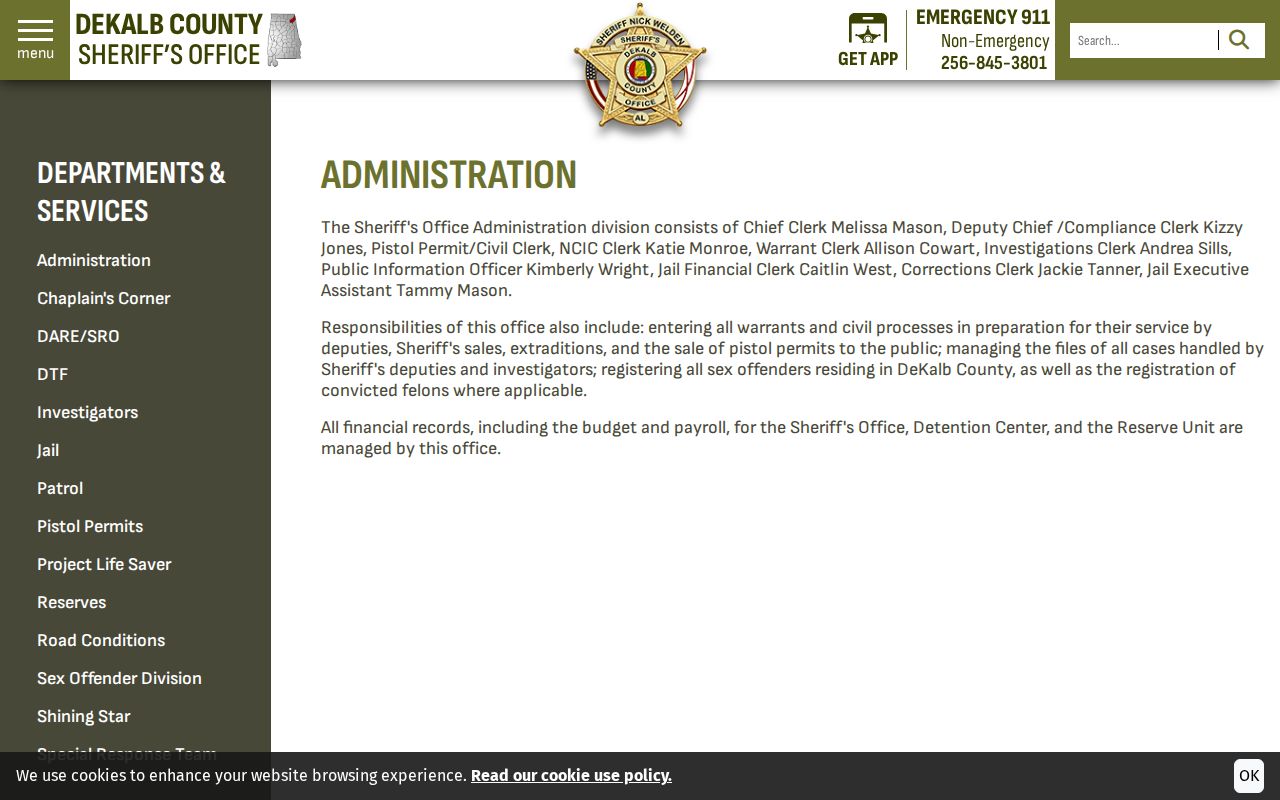
That entry work ends with warrants served by DeKalb County deputies. Ala. Code §15-10-2 covers execution at any time, notice of authority, showing the warrant on request, and entry after notice and refusal in specified conditions. It is not advice to resist or to consent. Once you are in custody, the practical questions are booking, bond, any holds, and the next setting.
DeKalb County Arrest Warrant Bond Questions
The Sheriff FAQ names four possible release types: own recognizance, a private bonding company, a property bond, and a cash bond. Each bond varies by offense, so the FAQ sends the public to the Detention Center for the exact type. No universal DeKalb County bond schedule exists to quote one amount.
Key point: Ask about the exact warrant, all holds, release terms, and next setting before arranging money or property.
Posting bond does not close the case. A hold from another city, county, state, or federal authority can still block release, so get receipts and written conditions before you leave a DeKalb County facility.
Arrest Warrant vs Summons vs Bench Warrant
An arrest warrant authorizes custody, a summons directs an appearance without it, and a bench warrant usually follows a missed duty in an existing case. Each DeKalb County record calls for a different response.
| Feature | Arrest Warrant | Summons | Bench Warrant |
|---|---|---|---|
| What it orders | Custody | Appearance | Custody for missed duty |
| Basis | Probable cause | Charge with appearance route | Failure to appear or comply |
| Issuer | Judge or magistrate | Authorized court process | Judge in existing case |
| Response | Confirm surrender and bond route | Appear as directed | Ask about reset or recall |
DeKalb County Public Search Limits
The sheriff's Most Wanted interface is curated, not a complete DeKalb County arrest-warrant index. Its Current and Arrested labels are program controls, and an Arrested label is not a final outcome. The linked disclaimer warns that public-source data may be inaccurate and are provided as is. The Alabama AOC Warrant Portal and NCIC sit behind law-enforcement restrictions. A blank public result can mean partial coverage, delay, another court, or a legal limit, so it proves nothing. Juvenile and youthful-offender records carry special confidentiality rules. For Circuit or District records, the clerk's formal form allows two weeks and cannot reach city or federal files.
What to Do If There Is a Warrant for You
Stop the broad online hunting once a likely match appears. Verify identity, status, charge label, court, case number, bond type, and reporting instructions with the sheriff and the issuing clerk. If city police started the matter, call that Municipal Court too. Counsel can discuss surrender, challenges, bond, and the underlying case; a clerk explains procedure but not legal strategy. Keep every paper after booking or release. Confirm the next court date yourself. Execution clears the service step, not the charge, and a web card vanishing from a DeKalb County page is not a court disposition.
Important: Do not travel to surrender based only on a web result. Confirm the DeKalb County warrant and reporting instructions first.
DeKalb County Record Request Route
The DeKalb County clerk works from one paper form. That form is the Request for Record Search and Copies. It wants a case number, your identifying details, a certification choice, and contact information, plus a stamped return envelope. Fees are posted plainly. A computerized name search runs $10. An archived search costs $25 in DeKalb County, and examining paper files runs $20. Copies and certification carry separate charges. Leave personal checks at home. Call (256) 845-8525 first to confirm what payment the DeKalb County office accepts. Mail everything to PO Box 681149, Fort Payne, Alabama 35968, with a self-addressed stamped envelope. The search itself can take two weeks. Keep the request narrow. Name the likely court, the case, the approximate date, and whether you need certification. The Circuit Clerk holds Circuit and District records only. A certified copy costs more than a plain copy, and some receiving offices want that formal proof. Now the limits. A blank result from this DeKalb County form is not countywide clearance. It cannot reach a Municipal Court, another Alabama county, another state, or the federal court. If the warrant names another agency or court, go to that office instead, since city matters belong with the named city clerk and federal ones run through the Northern District of Alabama and PACER. For live warrant status anywhere in DeKalb County, call the sheriff's warrant line.