
Bench Warrants in DeKalb County
A bench warrant is an order from the court in an existing matter. In DeKalb County, the clearest documented trigger is failure to pay or dispose of a traffic case before court and then failure to appear. Other failures to comply with a court order may also produce court process. The local public sources use “bench warrant” and “failure-to-appear warrant.” They do not confirm a separate county practice called “capias pro fine,” so capias should be treated only as a term a clerk may explain if it appears on a docket.
The underlying court matters. Circuit Court has felony trial jurisdiction. District Court handles misdemeanors outside municipal prosecution and felony preliminary work. Municipal Courts control their own traffic, ordinance, and city criminal cases. No complete public DeKalb County bench-warrant list was verified. A blank sheriff page or city payment portal is not clearance.
DeKalb County Missed-Date Warrant Route
Start with the notice, ticket, bond paper, or prior court order. The official Alabama failure-to-appear notice records the case number, missed date, charge, new court date, choice of court appearance or mailed payment, and the amount due. Those fields help the clerk locate the right file. They do not prove by themselves that a bench warrant has issued.
- Write down the case or citation number and missed date.
- Call the court that set the appearance before traveling.
- Ask whether a warrant issued and whether it remains active.
- Ask what the judge requires for a reset, payment, bond, or recall request.
The Sheriff FAQ gives (256) 845-8560 for outstanding-warrant questions. If staff identifies a Circuit or District file, the DeKalb court office directory routes criminal and traffic calls through the Circuit Clerk at (256) 845-8525.
How a Bench Warrant Is Issued
The judge acts in the case already before the court. When a required appearance or court condition is missed, the court may record the failure and issue a warrant authorizing law enforcement to take the person into custody. The official DeKalb Traffic Court warning says nonpayment combined with nonappearance may lead to a warrant, an increased fine, bond forfeiture, and ALEA license-suspension action.
After issuance, court staff and law enforcement maintain different parts of the process. The Circuit Clerk keeps Circuit and District case files. Municipal clerks keep city files. The sheriff’s administration materials describe an NCIC Clerk and Warrant Clerk who enter warrants and process for deputy service. Alabama’s AOC warrant portal and NCIC are restricted systems, not public lookup tools. The issuing court must confirm whether the order was later executed, recalled, or replaced by a new setting.
DeKalb County FTA Warrant Terms
Status words can look alike while marking different steps. Ask the clerk to translate the exact entry on the case rather than relying on a portal label.
- FTA
- Failure to appear at a required court setting.
- Issued
- The court authorized the warrant; it does not mean service occurred.
- Executed
- Law enforcement served the warrant or took the action recorded by the agency.
- Recalled
- The issuing court withdrew the warrant. Confirm the date and any new setting.
- Quash
- A request or order that sets aside the warrant; no local standard form was found.
“Arrested” on the sheriff’s Most Wanted interface is only a program status. It is not a final disposition, and it does not show that the underlying court case ended.
Bench Warrant vs Arrest Warrant
Both orders can lead to custody, but their starting points differ. A bench warrant usually follows a missed duty in an existing case. An arrest warrant follows a complaint and a judge or magistrate’s probable-cause review. The distinction affects which file to request and what question to ask the clerk.
| Feature | Bench Warrant | Arrest Warrant |
|---|---|---|
| Trigger | Missed setting or unmet court order | Probable cause tied to an alleged offense |
| Issuer | Judge controlling the existing case | Judge or magistrate after review |
| File route | Existing Circuit, District, or Municipal case | Issuing court plus sheriff or police |
| Next step | Ask about appearance, reset, bond, or recall | Ask about surrender, bond, counsel, and court date |
No DeKalb County Bench Warrant Grid
The official Most Wanted interface has a name box, Current and Arrested tabs, sort controls, Search, and Show All. It is a curated program, not a verified export of every DeKalb County bench warrant. Its linked disclaimer says data may be inaccurate and are provided as is. During research, the interface also reported that content was unavailable.
The Sheriff FAQ refers to a warrant database, but no working full-list route was exposed through the current site. That mismatch makes phone and court confirmation essential. A city warrant may remain in a Municipal Court file even when nothing appears in the county program. A recently issued, sealed, juvenile, youthful-offender, or law-enforcement-sensitive matter may also be restricted or absent.
Key point: No result on a partial public page is not proof that DeKalb County has no bench warrant.
How to Resolve a DeKalb County Bench Warrant
Only the issuing authority can record execution, recall, a new appearance, payment, or another disposition. DeKalb County does not publish a standard recall form, automatic-reset rule, filing fee, or warrant-amnesty process. Court staff can state procedure but cannot choose a plea or legal strategy. Counsel may be useful when custody, bond, or a recall motion is involved.
- Confirm the warrant, status, case number, and issuing court.
- Ask whether the court requires an appearance, payment, bond, or a filed motion.
- Call the jail at (256) 845-8565 before any surrender trip and ask about intake and bond routing.
- Obtain a receipt, written new date, and confirmation that the warrant record changed.
Caution: Online payment does not itself prove recall. Ask the issuing clerk to confirm the DeKalb County bench-warrant status.
DeKalb County Municipal Warrant Payment Limits
Municipal portals help with some balances, but none of the inspected city shells except Rainsville exposed citation-search fields. Even Rainsville’s tool searches a citation by last name plus citation or case number, or by last name plus date of birth. It does not display a complete city bench-warrant grid.
The official Rainsville city-government page shows the annex schedule and court contact used for that route.
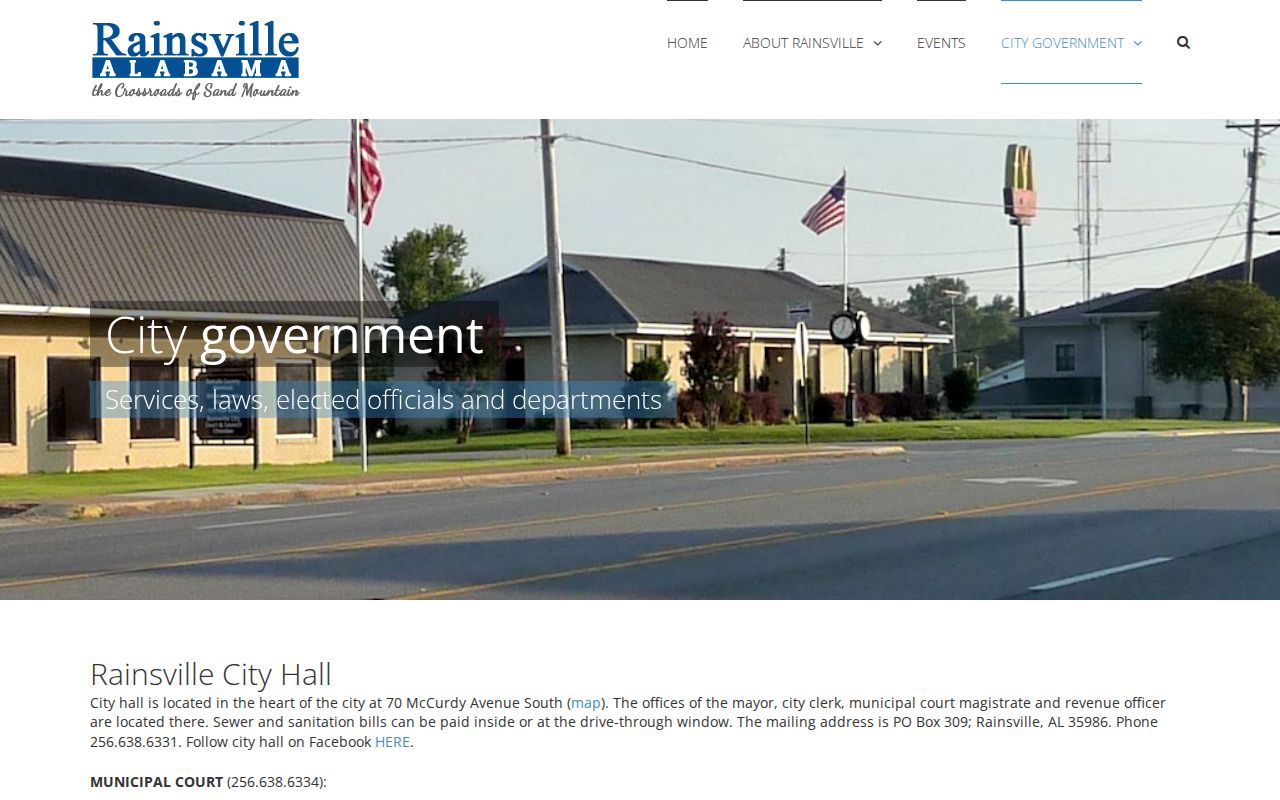
The captured court block reinforces why the city clerk, not a countywide list, is the source for a missed Rainsville setting.
Fort Payne Municipal Court meets Mondays at 4 p.m. and uses (256) 845-6728. Rainsville meets on the first, second, and fourth Tuesdays at 4 p.m., with payment review on the first Tuesday, and uses (256) 638-6334. Henagar meets the third Tuesday at 4 p.m. and uses (256) 657-7691. Collinsville routes through (256) 524-2135. Crossville meets the third Tuesday at 5 p.m. and uses (256) 528-7121 extension 4. Call the named city court about its own file.
Keep the payment receipt, the clerk’s status confirmation, and the written next setting. Those three items answer different questions and help prevent a paid balance from being mistaken for a recalled warrant.
Which DeKalb County Court Issued It
A felony matter points to Circuit Court. A misdemeanor outside city prosecution or felony preliminary matter points to District Court. A city ticket, ordinance charge, or city-police misdemeanor points to that Municipal Court. Alabama does not use a Texas-style justice-of-the-peace court in this county structure. Magistrates act within the Unified Judicial System and have statutory warrant authority.
DeKalb County Circuit Clerk Todd Greeson keeps Circuit and District records at 300 Grand Avenue South, Suite 200, Fort Payne. The formal record-search and copies form allows two weeks and asks for the case number, identifying details, certification choice, requester contact data, and a stamped return envelope. It cannot supply municipal or federal records. A $10 computerized name search and other listed copy or certification fees may apply; personal checks are not accepted.
Call Before a DeKalb County Appearance
No official DeKalb walk-in surrender handout or promise of arrest-free “walk-through” treatment was located. Before going to a courthouse, city hall, sheriff headquarters, or jail, ask where to report and whether identification, payment, bond, counsel, or a court order is needed. Sheriff headquarters is at 2801 Jordan Road SW, but the warrant line should direct the trip.
The Sheriff FAQ lists own-recognizance, private-company, property, and cash bond as possible types. It also says bond varies by offense. There is no countywide amount to quote. Ask the jail for the type tied to the exact warrant and whether another city, county, state, or federal hold appears. Bond release does not end the underlying case.
After action is taken, confirm both the warrant status and the next court duty. A receipt can show payment, while a court entry shows recall or a new date. Neither should be inferred from a disappearing web result.